
Leachate Treatment
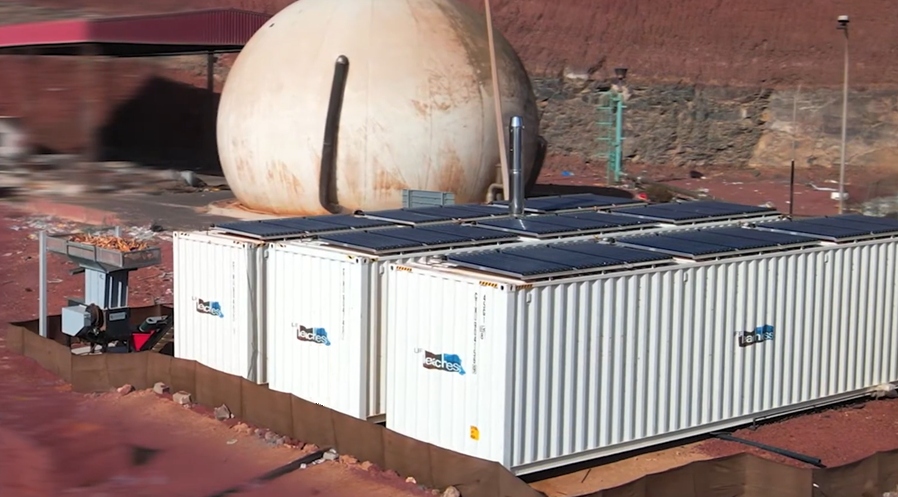
Our plants treat leachate on site, eliminating transportation cost and its carbon footprint.
Innovative on-site treatment with low electrical consumption
The technology developed by TRITON, the Leachless System, is installed in the place where leachate is generated, avoiding the economic costs and carbon footprint of transportation to external treatment facilities.
The combination of the use of low energy consumption technologies with the incorporation of renewable energies greatly reduces electrical energy consumption per m3 of treated leachate.
Evaporation with renewable energies followed by direct osmosis, the key to the success of LEACHLESS
LEACHLESS combines a leachate evaporation and condensation process, followed by a direct osmosis stage.
The multiple-effect vacuum evaporation process minimizes the necessary heat, which is also obtained through renewable energy, valorising other waste such as biomass or biogas generated in the landfill, incorporating the precepts of the Circular Economy.
The forward osmosis process takes advantage of the natural phenomenon whereby osmotic pressure drives the diffusion of water through a semipermeable membrane while solutes are retained.
Direct osmosis does not work at high pressure, so it is a process with very low energy consumption.
Higher performance and better water quality
LEACHLESS recovers between 85% and 95% of the water from leachates, a much higher percentage than that obtained with other technologies on the market.
Due to its high quality, the water obtained with the LEACHLESS System is suitable for all types of reuse, collaborating in the conservation of the water resource, or it can be returned to the environment safely, protecting the hydrographic environment.
Product uses
The LEACHLESS System is a technological solution for the treatment of leachate and polluted wastewater from different sectors.
Solid waste management
- Landfill Leachate
- Leachate and effluents from MBT plants
- Biomethanization liquid effluents
- Leachate from other waste management infrastructure

Other industrial sectors
- Wine industry
- Juice manufacturing
- Meat industry
- Textile industry
- Pharmaceutical industry
Advantages and benefits
Maximum water recovery
The performance of our plants extracts from leachate the greatest possible amount of water suitable for all types of reuse.
Low energy costs
Minimum energy consumption compared to high electrical consumption in aeration equipment in biological treatments and high pressure pumps in reverse osmosis treatments.
Waste valuation
Energy recovery of wood waste (biomass) and biogas produced in landfills.
Lower volume of concentrate
The pollutants in the leachate are concentrated in a volume up to 5 times smaller than that obtained with other technologies, facilitating their immobilization at low cost through drying, stabilization, solidification or recovery, and turning the installation into a ZLD system (zero liquid discharge).
Lower environmental impact
Without a carbon footprint due to the transport of leachates or concentrates, valorising biogas and/or biomass and with minimal energy consumption, our plants help reduce the environmental impact of landfills and waste management facilities.
FAQs
What is leachate?
Leachate is the liquid resulting from the percolation of water through solid waste, generally referred to in the case of landfills or controlled solid waste deposits.
As a consequence of the circulation of water through waste, leachates are liquids with high concentrations of pollutants of all types (originally contained in the waste or product of its decomposition), which is why they are a potential source of soil pollution, as well as both surface and groundwater.
How is leachate managed?
The first step in leachate management is to prevent its percolation into the subsoil at the point of origin. To do this, in controlled deposits, the basin that receives the solid waste has a physical barrier (geomembrane) that makes it waterproof and a leachate collection system that usually discharges into a pond (also waterproofed).
Once the leachate is contained, it continues to be a potential vector of contamination, so it must be treated.
Historically, landfill leachate was sent to municipal wastewater treatment plants, where it was treated along with sewage; however, the negative impact of leachate on wastewater treatment processes means that this alternative has been gradually limited and, in many cases, finally abandoned.
It is necessary to incorporate a specific treatment to treat any leachate.
What does on-site treatment of leachate mean?
An on-site treatment of liquid waste is carried out in the same place where that waste is generated, in the case of leachate in the landfill or controlled deposit itself.
In contrast, external treatments are those carried out in polluting liquid treatment plants (often run by private operators) that receive and jointly treat leachate and other effluents from different sources.
The main advantage of “in situ” treatments is that the transport of leachate by tanker truck from the source (landfill) to the treatment plant, which may be located dozens or hundreds of kilometres away, is completely avoided. 100% of transportation costs are eliminated, as well as the associated environmental impact (carbon footprint and potential contamination of soils and aquifers during the loading, transfer and unloading of leachate).
What is the LEACHLESS System?
The LEACHLESS System is an innovative technology for the on-site treatment of leachates, with low energy costs, developed by TRITON.
LEACHLESS combines a leachate evaporation and condensation process, followed by a direct osmosis stage.
The evaporation process is carried out using renewable energy (solar, biomass, biogas, use of residual heat, etc.), and direct osmosis is a process with very low energy consumption, since it works at low pressures.
A final effluent (recovered water) of high quality is obtained, which allows both its reuse (irrigation, cleaning…) or its return to the environment in a safe way.
What is Forward Osmosis?
The forward osmosis process takes advantage of the natural phenomenon whereby osmotic pressure drives the diffusion of water through a semipermeable membrane while solutes are retained.
On one side of the membrane is the leachate and on the other a high salinity solution (commonly a solution of common salt, or brine) which is called entrainment solution. The water passes from the leachate, which is concentrated, to the drag solution, which is diluted. In a final step, the stripping solution is concentrated again, recovering the water as a final effluent. There are different processes for recovering the drag solution, the best solution being selected case by case.
Unlike reverse osmosis, forward osmosis occurs in the same direction as natural osmosis, so it does not require external energy to drive water diffusion.
What advantages does LEACHLESS have over other leachate treatment methods?
Currently the most widespread approach for leachate treatment is a combination of biological treatment, followed by ultrafiltration and one or more stages of reverse osmosis. This treatment line has high energy consumption (blowers for biological aeration, high pressure pumps for reverse osmosis) and the water recovery rate is very limited by the pressure required in the reverse osmosis stages, usually below of 65%.
On the contrary, the LEACHLESS system recovers between 85% and 95% of the water from the leachate, with half the energy consumption required by other treatment methods.
Additionally, LEACHLESS contributes to the circular economy by energy recovery of other waste and by-products such as biomass (wood waste) and biogas (generated by the decomposition of waste in the landfill).
What are LEACHLESS treatment plants like?
LEACHLESS treatment plants are made up of three different treatment units:
- Energy generation from renewable sources
- Vacuum condensation evaporation system
- The forward osmosis system
Each of the three units can be mounted inside a maritime container or their components can be installed inside an engine room.
The LEACHLESS treatment plants are easy to install, you only have to interconnect the different containers, feed the leachate from the leachate pond of the landfill and connect the recovered water outlet to reuse or discharge.